
Engineering for Evolution: Building Software That Makes Itself Better
The Lightbulb Moment
We were building a photo culling tool—software to help a sports photographer sort through 25,000 images from a weekend of cross-country meets, quickly separating the keepers from the rejects.
The obvious approach: build something fast. Keyboard shortcuts. Quick previews. Batch operations. Ship it.
But then we asked a different question: What if every decision the photographer makes today becomes training data for automation tomorrow?
That question changed everything about how we built the tool. And it represents a fundamental shift in how we think about software development.
The Principle: Designed Succession
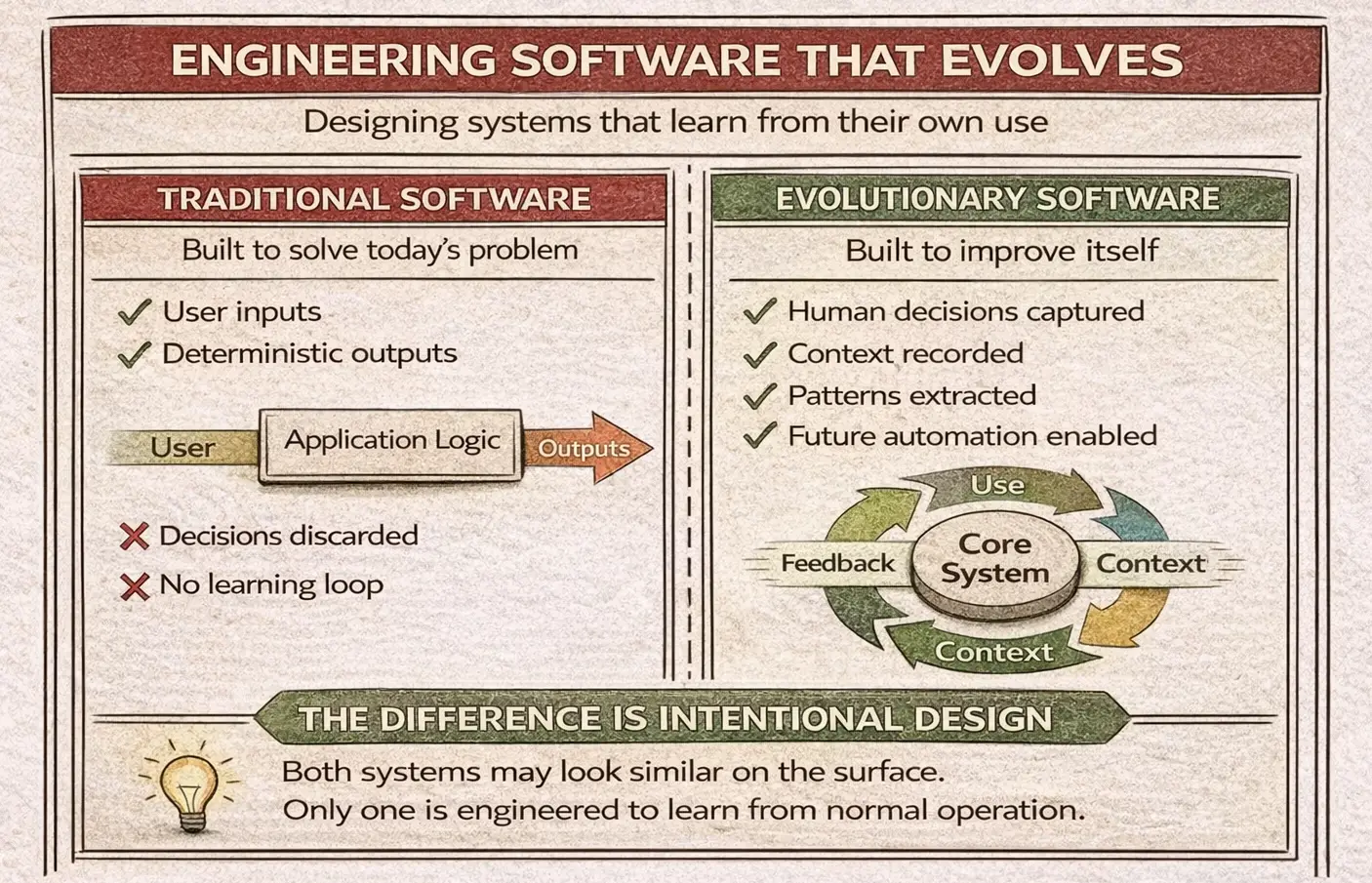
Most software is built to solve a problem. Full stop. You define requirements, write code, ship it, maintain it until it's replaced by something else entirely.
Evolutionary engineering takes a different approach: build software that captures the knowledge needed to build its successor.
This isn't theoretical. You've already used systems built this way—you just didn't know it.
reCAPTCHA: The Canonical Example
Remember when CAPTCHA challenges showed you two distorted words? One word verified you were human. The other word was from a scanned book that computers couldn't read. Your answer helped digitize that text.
By 2011, reCAPTCHA had digitized the entire Google Books archive and 13 million New York Times articles dating back to 1851. Millions of humans, solving their own verification problems, collectively taught machines to read.
Then the system evolved. Those "click all the traffic lights" challenges? They trained computer vision systems for autonomous vehicles. Every time you proved you weren't a robot, you taught robots to see.
The pattern: The primary function (verify you're human) served users. The secondary function (label training data) served the system's evolution. Neither compromised the other.
Tesla's Shadow Mode
Every Tesla on the road runs its Autopilot system in "shadow mode"—even when the driver is in full control. The car constantly compares what its AI would have done against what the human actually did.
When they diverge, that's signal. That's data. That's a lesson.
Tesla's fleet of millions of vehicles became a massive, distributed training operation. Every edge case a human driver navigates—the unexpected construction zone, the pedestrian stepping off the curb, the ambiguous merge—becomes curriculum for the next software update.
The insight: The cars aren't just transportation. They're mobile classrooms where humans unknowingly teach machines to drive.

Our Application: Photo Culler
A professional sports photographer captures 25,000+ images per weekend. The culling process—deciding which shots are keepers—requires rapid-fire judgment calls:
- Is the runner's form compelling?
- Are the eyes in focus?
- Is the composition balanced?
- Does this moment tell a story?
These decisions happen in fractions of a second. Expert photographers can't fully articulate why one image works and another doesn't. It's pattern recognition built from years of experience—what we might call professional intuition.
We tried to automate this. We explored existing AI models for image quality assessment. Dead end. The models could detect blur and exposure problems, but they couldn't judge whether a photo of a runner captured that perfect moment of athletic grace.
The training data for "compelling sports photography" simply doesn't exist.
So we decided to create it.
The Architecture of Learning
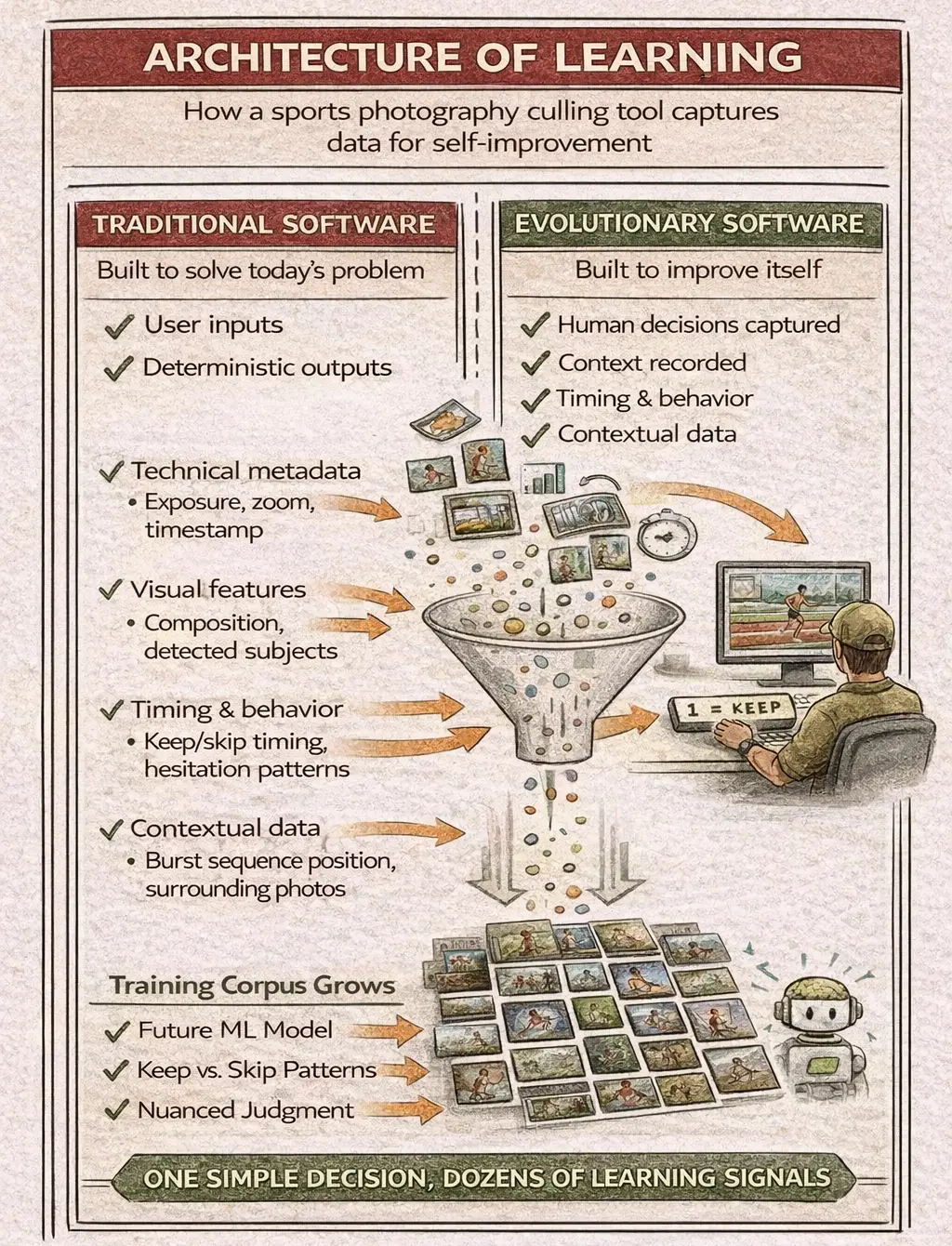
Photo Culler looks like a simple tool: images appear, the photographer presses "1" to keep or right-arrow to skip. Fast, efficient, purpose-built for high-volume workflows.
But underneath, every decision triggers a cascade of data capture:
What we record:
- The decision itself (keep/skip)
- The image's technical metadata (exposure, focal length, timestamp)
- Extracted visual features (composition metrics, detected subjects, pose estimation)
- Contextual data (position in burst sequence, time between decisions)
- The photographer's hesitation patterns (decision timing, back-tracking behavior)
What this enables:
- Training data for future ML models
- Analysis of what distinguishes "keeper" patterns from "reject" patterns
- Understanding of how expert judgment varies by event type, lighting, sport
- A foundation for semi-automated culling suggestions
The photographer doesn't do anything extra. They're just doing their job, making the decisions they'd make anyway. The system learns by watching.
The Art of Capturing Nuance
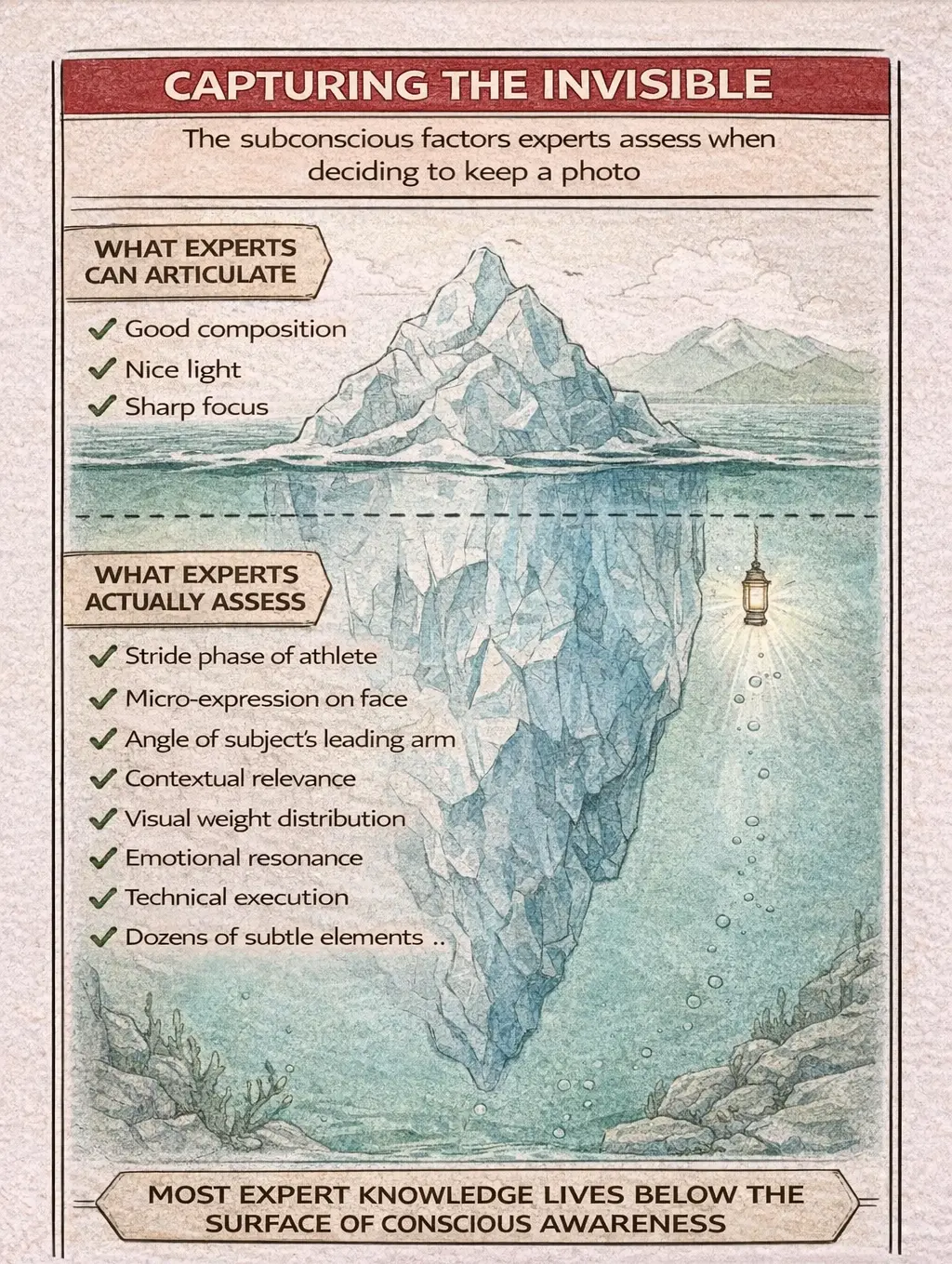
Here's what makes evolutionary engineering genuinely difficult: expert knowledge is mostly invisible, even to experts.
Ask a master photographer why they kept a particular shot, and they'll give you surface-level answers: "Good composition." "Nice light." "Captures the emotion."
But the real decision involves hundreds of micro-assessments happening below conscious awareness:
- The angle of the athlete's leading arm
- The relationship between subject and background
- The micro-expression on the runner's face
- The position within the stride cycle
- The visual weight distribution across the frame
Traditional requirements gathering can't capture this. You can't interview your way to this knowledge. It only emerges through observation of actual decisions in context.
The evolutionary approach inverts the problem. Instead of trying to extract and codify expert knowledge upfront, you build systems that capture decision-making in action. The patterns reveal themselves over thousands of examples.
This is how expertise actually works in human learning too. A chess grandmaster doesn't consciously calculate why a position "feels" dangerous. Their brain has internalized patterns from thousands of games. Evolutionary engineering creates the same foundation for machines—but deliberately, systematically, and at scale.
From Data to Wisdom
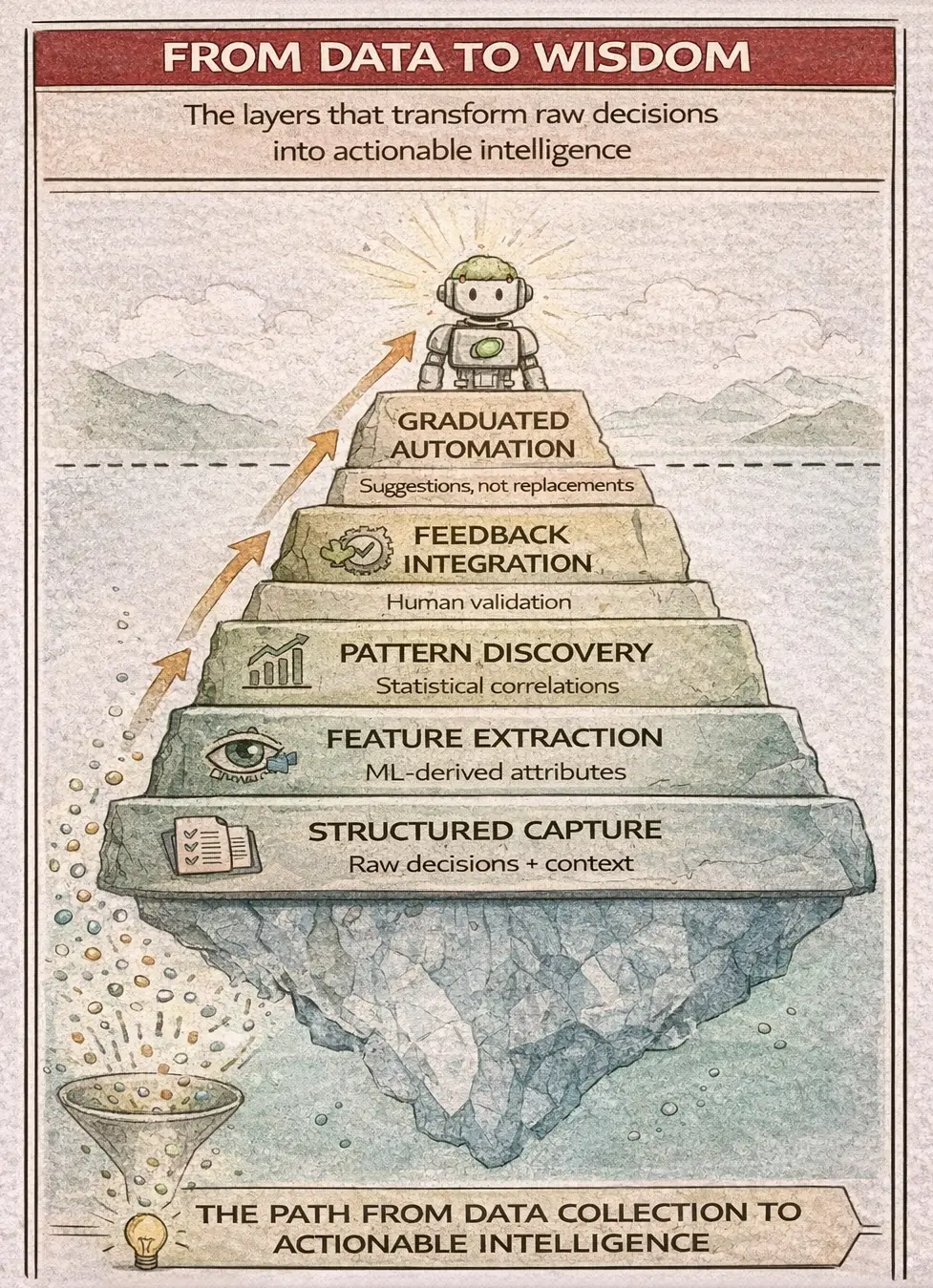
Collecting data is step one. The transformation into "software wisdom" requires intentional design at every layer.
Layer 1: Structured Capture
Raw decisions aren't enough. You need to capture context that makes decisions meaningful. A "keep" decision means something different for a finish-line shot versus a mid-race pack photo. The system must understand what kind of decision it's observing.Layer 2: Feature Extraction
Modern ML can extract features humans would never think to measure. Body pose estimation gives us joint angles and stride phases. Composition analysis reveals visual weight distribution. Face detection finds expressions. These become the vocabulary for pattern recognition.Layer 3: Pattern Discovery
With enough labeled examples, patterns emerge that even experts didn't know existed. Maybe there's a specific hip-to-shoulder angle that correlates with "keeper" decisions in sprint photography. Maybe certain background blur ratios predict higher keeper rates. The data surfaces what intuition obscures.Layer 4: Feedback Integration
The system doesn't just learn passively. As patterns emerge, they can be surfaced back to users: "Images like this are kept 73% of the time." Human experts can validate, refine, or reject these discovered patterns—creating a dialogue between human judgment and machine observation.Layer 5: Graduated Automation
Eventually, the system knows enough to make suggestions. Not replacements—suggestions. "Based on your historical preferences, these 47 images are likely rejects. Review?" The human stays in control, but the cognitive load drops dramatically.
Why This Matters for Business Software
Photo culling is a specific example. The principle applies broadly.
Consider these business applications:
Sales proposal systems that track which sections buyers engage with, which objections arise, and which deals close—building toward proposals that self-optimize for conversion.
Customer support platforms that learn which response patterns resolve issues fastest, which escalation paths work, and which customer segments need different approaches.
Marketing automation that doesn't just A/B test headlines but captures the full decision context of what content resonates with which audience segments under which conditions.
Product analytics that go beyond measuring what users do, to understanding the judgment calls your team makes in response—creating institutional knowledge that survives employee turnover.
In each case, the pattern is identical:
- Build a tool that solves today's problem
- Instrument it to capture decision-making in context
- Extract features that characterize those decisions
- Discover patterns that enable future automation
- Keep humans in the loop as validators and guides
The software doesn't just help. It learns. And what it learns becomes the foundation for its own improvement.
The Competitive Implications
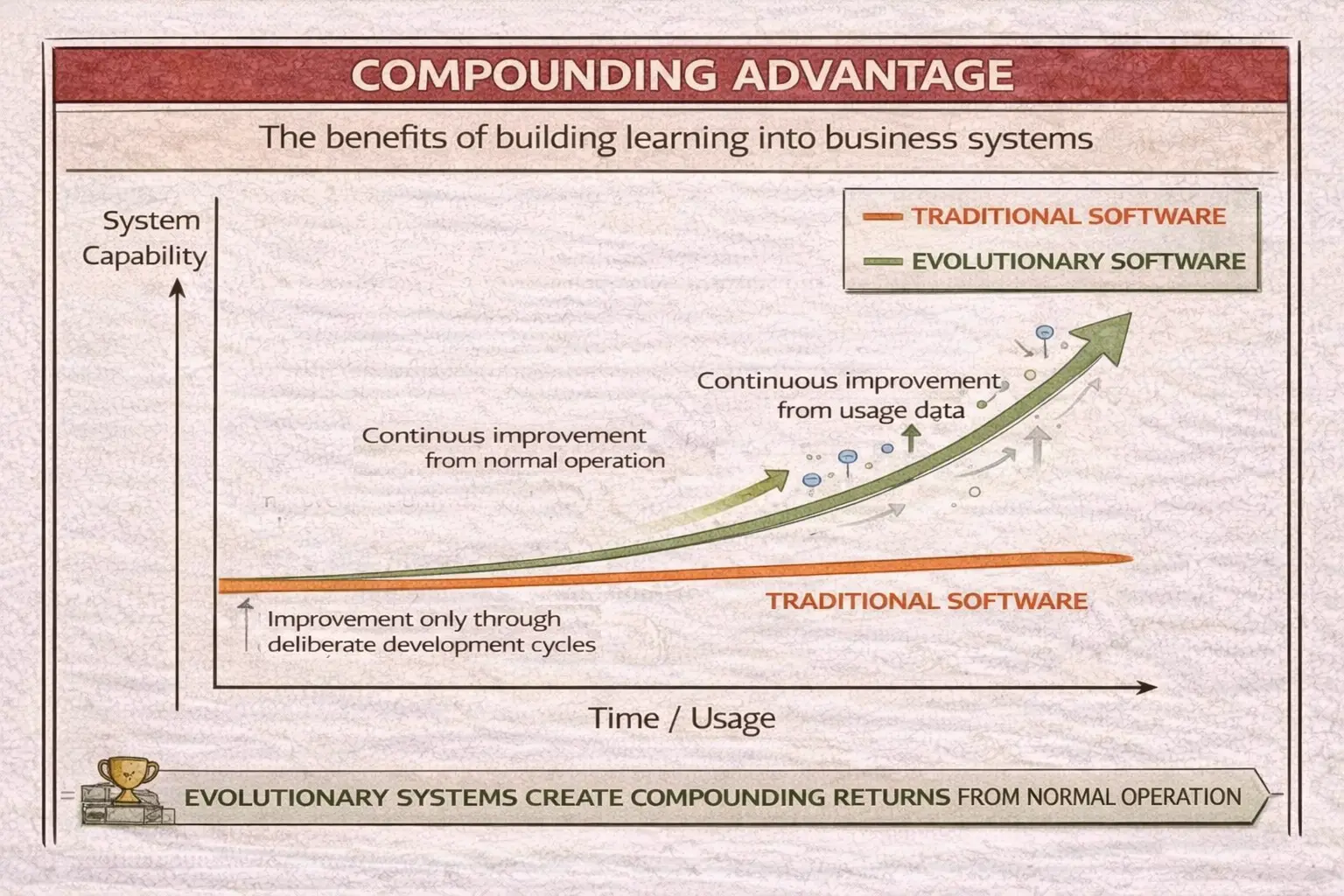
Companies that build evolutionary systems create compounding advantages:
Data moats: Every user interaction makes the system smarter. Competitors starting from scratch face an ever-widening gap.
Institutional memory: When an expert employee leaves, their judgment patterns stay embedded in the system's training data.
Continuous improvement: The system gets better automatically, without dedicated R&D investment for each enhancement.
Defensible differentiation: You're not just selling software features. You're selling accumulated wisdom that can't be replicated by copying code.
Tesla understood this early. Their cars aren't just vehicles—they're data collection platforms that make the driving AI better every day. That's why their self-driving capability compounds while competitors struggle to catch up.
The same dynamic applies to business software. The question is whether you're building tools, or building tools that build themselves.
Building Your Own Evolutionary System
If this approach resonates, here's how to start thinking about it for your own applications:
1. Identify Human Judgment Points
Where in your workflow do skilled people make decisions that are hard to articulate? Those are candidates for evolutionary capture.2. Design for Passive Collection
Users shouldn't have to do extra work. The best training data comes from people doing their jobs normally, with capture happening invisibly.3. Capture Context, Not Just Outcomes
A "yes/no" decision without context is nearly useless. You need the full picture: what was the user looking at, what had they seen before, what were the alternatives?4. Plan for Feature Extraction
Modern ML can extract attributes you'd never think to measure. Build in the hooks for later analysis, even if you don't know exactly what you'll analyze yet.5. Keep Humans Central
Evolutionary engineering isn't about replacing human judgment. It's about capturing human judgment so it can be amplified, shared, and eventually assisted by automation.The Bottom Line
Software that merely solves problems is table stakes. Software that learns from solving problems—that captures the wisdom embedded in human decisions—creates lasting competitive advantage.
We built Photo Culler to help a photographer work faster today. But we engineered it to become smarter tomorrow, turning thousands of keep/skip decisions into training data for future automation.
The tool works. The photographer processes images faster than ever. But the real value compounds invisibly: every session makes the system more capable of understanding what makes a photo worth keeping.
That's evolutionary engineering. Building systems designed not just to succeed, but to succeed themselves.
Envigna builds purpose-fit business software using modern tools and hard-won experience. If you're interested in systems that don't just solve today's problems but actively learn to solve tomorrow's, let's talk.